Phase 1: 'Activation'
When you bring Claude for Enterprise to your team, you're not just deploying new technology - you're unlocking new ways of working. The organizations seeing the greatest impact share a common foundation: three change management principles that turn initial curiosity into sustained transformation:
- Lead from the top
- Org-wide growth mindset
- Consistent practice of sharing success & celebrating wins
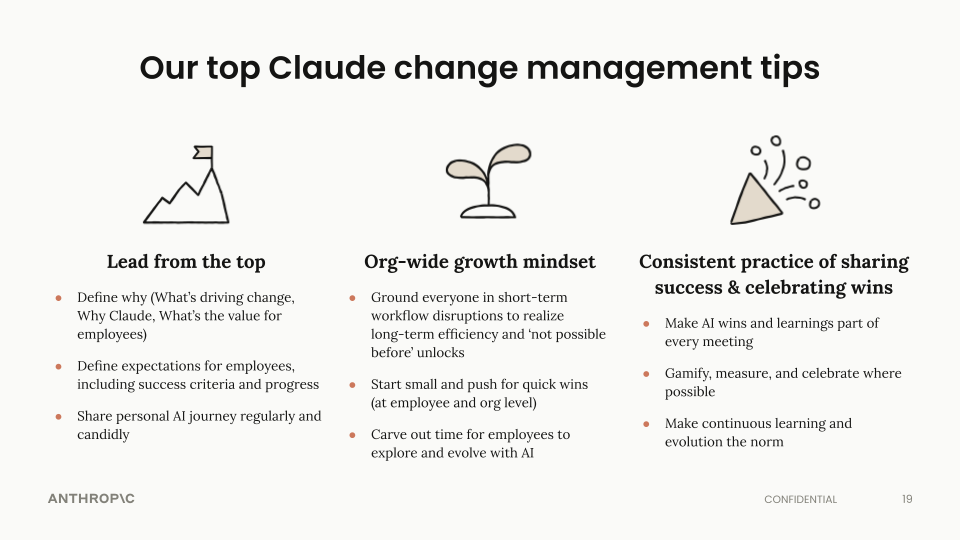
Launching now? Establish these pillars early!
Already launched? Weave them into your current journey. Our most successful customers maintain focus on these principles throughout their entire adoption journey, and they reward those who begin at any stage.
In the next section, we’ll walk you through what these three principles look like in practice.
Lead From The Top
Start with Your ‘Why’
When driving organizational change, people naturally ask "Why?" Clearly articulating your rationale isn't just helpful, it's essential for success. This foundation ensures your launch steps align with your unique business objectives.
Organizations choose Claude to navigate the rapid pace of AI transformation. Success requires more than technical training, it demands purposeful communication, value alignment, and meaningful motivation. Research shows that understanding "why" drives sustainable behavior change.
Common drivers for adopting Claude include:
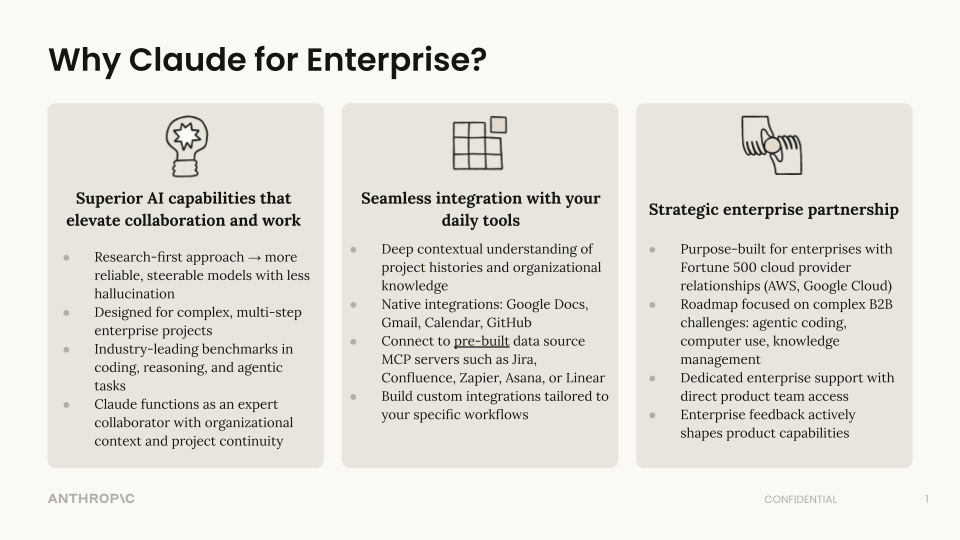
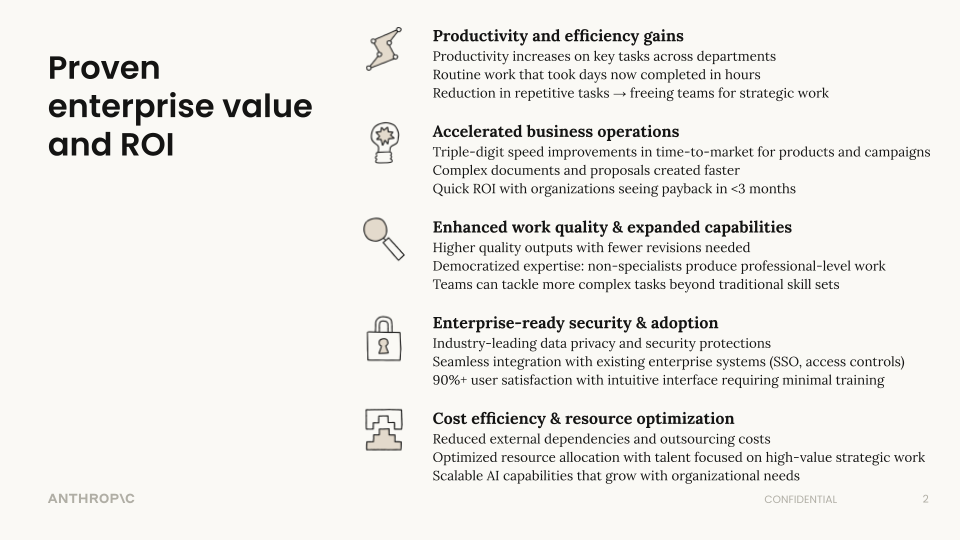
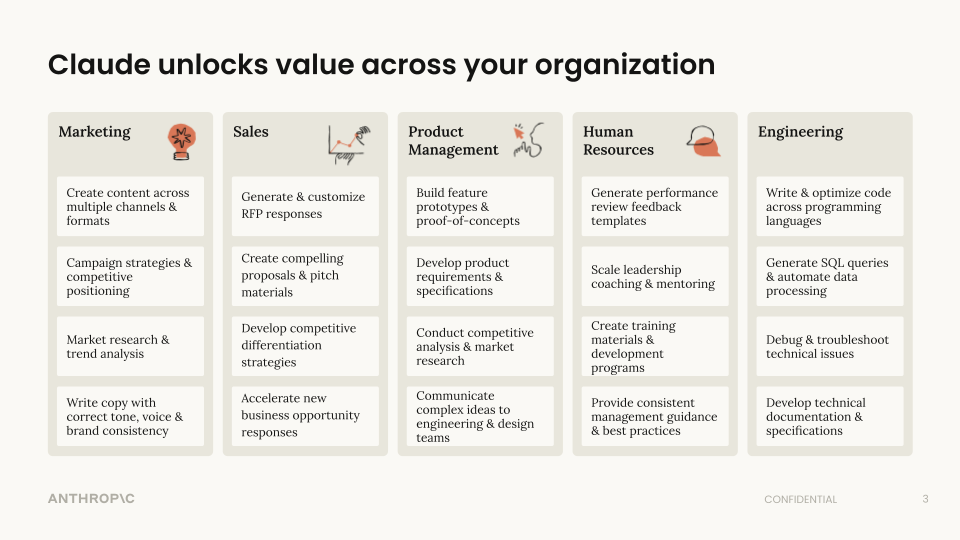
Connect Benefits to your Goals
Connecting your business objectives and strategy into your desired outcomes with Claude is key to ensuring the most measurable, impactful results for your organization:
|
Claude Enterprise Benefit |
Map to Business Objective |
|
Enhanced productivity across teams |
Increase operational efficiency and reduce time-to-market |
|
Advanced reasoning for complex business problems |
Improve strategic decision-making and competitive advantage |
|
Enterprise-grade security and compliance |
Meet regulatory requirements and minimize risk exposure |
|
Scalable AI integration |
Drive digital transformation and organizational agility |
|
Cost-effective knowledge work amplification |
Optimize labor costs and maximize ROI on human capital |
Craft your Compelling ‘Why’ Statement
Throughout your evaluation, you may have already identified the objectives you are trying to achieve with the help of Claude. No need to recreate the wheel! Now is the time to coordinate those thoughts.
The key here is for your organization to align on your reason why adopting Claude connects to your overall mission and business strategy. Take the time to document your organization's “Why” statement and get your Executive Stakeholder’s sign off on the definition.
Example "Why Claude for your Organization"
At "Organization", we're implementing Claude for Enterprise to fundamentally transform how our teams approach complex problem-solving and strategic decision-making.
This AI partnership will enable our workforce to focus on high-value creative and analytical work while Claude accelerates routine research, documentation, and process optimization. We're committed to supporting every team member through this transformation with comprehensive training and clear guidelines for ethical AI integration.
Our goal is to amplify human expertise across all departments, creating competitive advantages through enhanced productivity and breakthrough analytical capabilities. This represents our strategic investment in building an AI-augmented workplace where technology serves our people and our mission.
Together, we will establish "Organization" as a leader in responsible AI adoption while maintaining our core commitment to human-centered innovation.
Example Questions to Help You Develop Your Why
- What are your core business objectives for this adoption?
- How does AI integration align with your overall company strategy and values?
- What does success look like for your AI implementation? If you look into the future, what do you hope to see / what would you want your legacy to be, related to AI transformation?
- Are there specific metrics within the organization that you hope this implementation will have an impact on?
- How do you anticipate approaching this change? How will you support staff throughout the change?
- How might you articulate the role of the human and AI? What does your ideal AI-human collaborative workplace look like?
Org-Wide Growth Mindset
Successful Claude implementation goes beyond technical setup - it requires creating an environment where employees feel empowered to experiment, learn, and adapt. Here's the reality: most of your team will need time to explore, think through workflow adaptations, and build AI skills. Initially, productivity may slow down. This is not just normal - it's expected.
Research reveals two non-negotiable foundations for AI adoption success:
- Growth Mindset - Teams viewing AI as expanding their capabilities (not threatening their roles) achieve significantly higher adoption rates and better outcomes.
- Psychological Safety - When employees feel secure enough to test approaches, share challenges, and iterate without fear, AI integration accelerates naturally.
These cultural elements determine how smoothly your organization navigates the learning curve that accompanies any transformative technology.
Understanding the Productivity J-Curve: Why Initial Challenges Are Expected
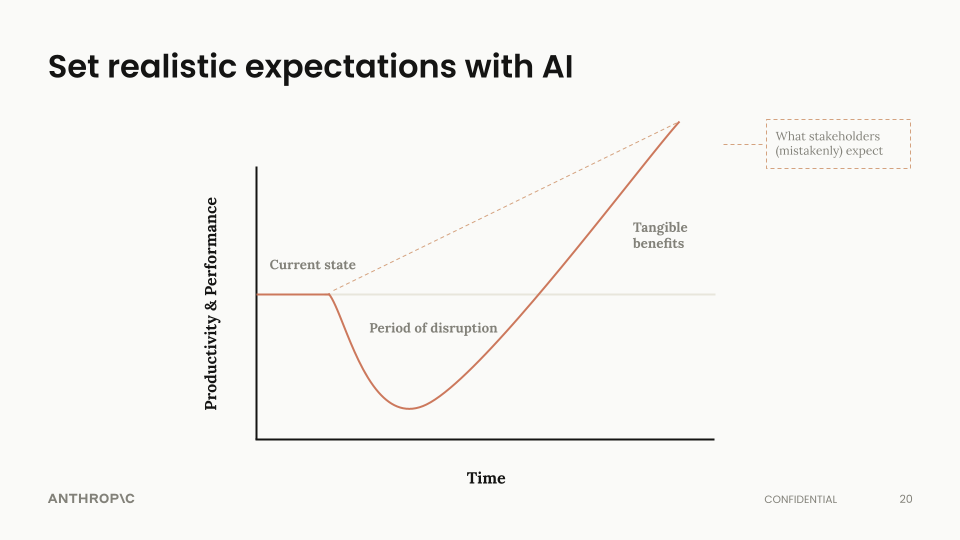
Here's the reality that every successful AI implementation shares: productivity will dip before it soars. But here's the empowering part - this isn't a bug, it's a feature of transformational change that you can navigate confidently.
When organizations first adopt Claude, they invest heavily in learning, experimenting, and adapting. These efforts create immediate costs but delayed returns, what MIT economists call the "productivity J-curve." Think of it as building your launchpad. The initial dip represents your team gaining altitude for the eventual breakthrough.
Historical proof lives everywhere around us. Electrification took a generation to pay off because factories needed complete redesigns to harness electric motors' flexibility. Today's successful Claude implementations follow the same pattern: initial experimentation gradually reveals optimal use cases, refined workflows, and team-specific best practices that multiply productivity.
Why This Matters for Your Implementation: Understanding the J-curve helps set realistic expectations and provides context for why psychological safety is so critical. When leadership expects and communicates that initial productivity dips are normal parts of the learning process, employees feel safer experimenting and iterating rather than being pressured to demonstrate immediate mastery. Organizations that understand this pattern are more likely to maintain investment in training and support during the crucial learning period, ultimately reaching the productivity gains that justify the transformation effort.
The J-curve also explains why many AI implementations fail, organizations pull the plug during the dip, never reaching the inflection point where everything clicks.
How you can build psychological safety for your employees and for your rollout
Creating this environment requires intentional leadership action. Here are the essential elements successful organizations implement:
- Normalize Learning and Experimentation:
- Frame working with Claude as a journey, not an instant skill. Share real stories of teams iterating from challenge to breakthrough as this builds permission to experiment.
- Address Fears Head-On:
- Acknowledge legitimate concerns about changing roles and responsibilities. Be clear: Claude augments human capabilities, and you'll support everyone through the transition.
- Model Growth Mindset from Leadership:
- Have leaders openly share their Claude learning journey (mistakes included)! When executives model continuous learning, it signals this is everyone's path forward.
- Create Safe Spaces for Questions:
- Establish judgment-free forums where any Claude question is welcomed. Make seeking help a strength, not a weakness.
- Reward the Journey, Not Just Wins:
- Celebrate teams who experiment boldly, share valuable lessons from attempts that didn't work, or help colleagues build AI skills. The learning process itself drives long-term value.
This foundation doesn't just enable Claude implementation, it creates the cultural momentum to continuously evolve as AI capabilities advance. You're building not just an AI adoption program, but an organization that thrives on intelligent collaboration.
Consistent practice of sharing success & celebrating wins
Successful Claude adoption thrives on recognition. When teams systematically share their AI wins, from productivity gains to breakthrough solutions, you create momentum that drives organization-wide engagement. Companies that consistently celebrate achievements see dramatically higher adoption rates and sustained technology engagement.
Build your success culture: Establish formal mechanisms to identify wins, measure impact, and amplify stories throughout your organization. This transforms AI from a tool into a transformative capability, inspiring continuous exploration, innovation, and adoption
Define what you are measuring to determine success
We work with thousands of companies to transform the way they work via implementing Claude into their day to day. With their rollouts, we find that most of those companies pursue goals across a transformation spectrum from productivity unlocks to work that was previously impossible.
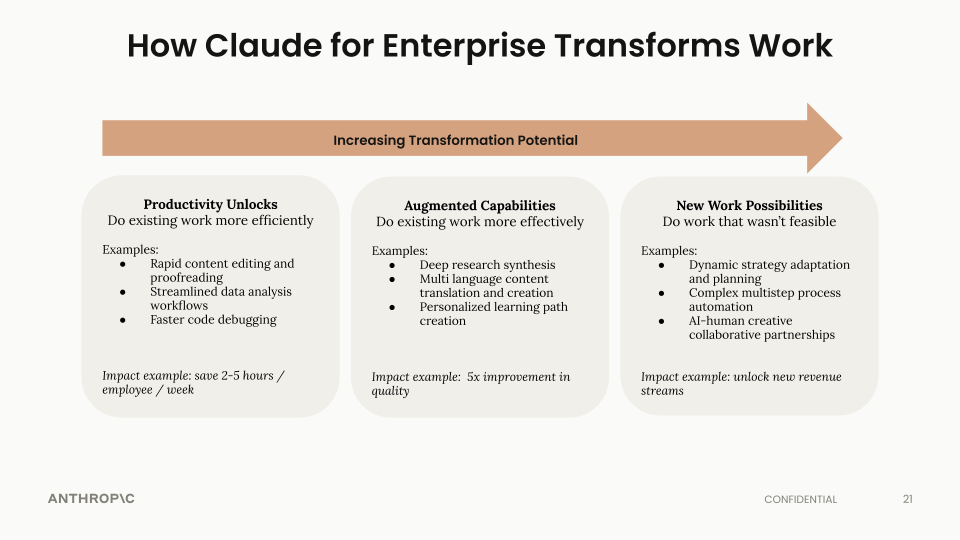
Your success starting point: Based on your company's "why," you likely fall somewhere on this spectrum. Many begin with productivity goals and progress toward breakthrough possibilities. Choose your metrics now and they will become easier to track once you've defined what matters most.
Leading and Lagging Indicators
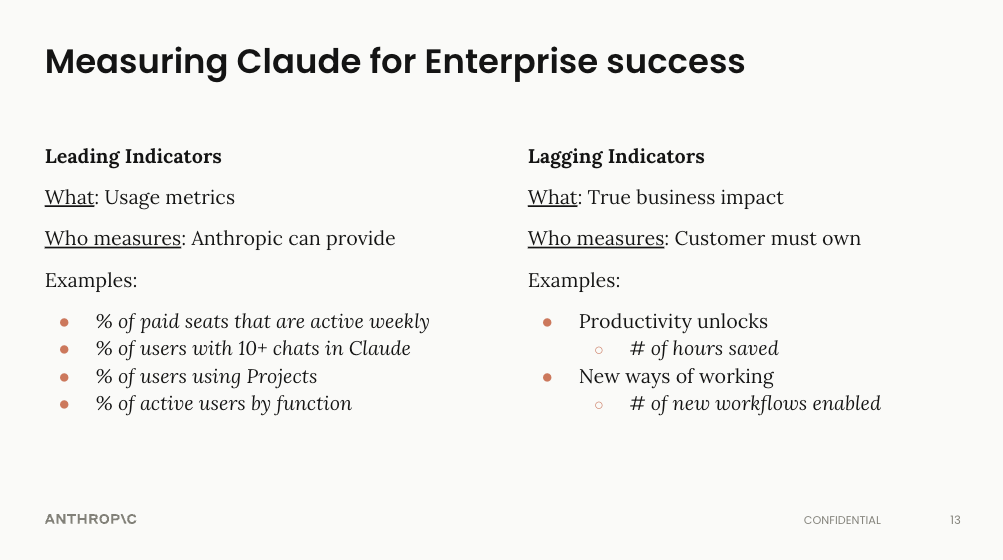
To measure success immediately and over time, define and capture both leading and lagging indicators.
Leading indicators
A leading indicator is a measurable metric that predicts or signals future performance outcomes before they occur, enabling proactive management decisions rather than reactive responses to past results. It provides real-time adoption signals through usage metrics that you can pull directly through audit logs. This data can include:
- User activation rates and conversation patterns
- Cross-functional adoption metrics
- Feature utilization across time periods (7-day, 30-day, all-time)
- Engagement leaderboards and file upload patterns
These quantitative measures predict long-term success before business impact becomes apparent. More information on how to create the dashboard in our Help Center article.
Lagging indicators
A lagging indicator is a measurable metric that reflects outcomes or performance results that have already occurred, providing confirmation of trends and patterns after organizational changes or initiatives have taken effect. This can not be extracted from usage alone - we recommend surveys to measure this:
- Productivity focus: Time savings, task efficiency, streamlined workflows
- Augmented capabilities: Decision quality, analytical capacity, output sophistication
- New possibilities: Breakthrough innovations, impossible-to-possible projects, novel value creation
Design surveys to capture evidence of your specific business impact, ensuring metrics match your transformation goals. See the attachment for an example survey you can roll out across your organization.
Example survey questions
Take a look at the attached PDF for some sample questions and recommendations for implementing a survey.
Each measurement builds your success story and creates data that proves ROI and guides your next expansion phase.
Create mechanisms for sharing
Your organization is ready for transformation. By weaving Claude success stories into your existing culture, not creating new overhead, you'll inspire widespread adoption and unlock collective potential.
Leverage Your Existing Channels No need to reinvent the wheel. Partner with Internal Communications to identify where your teams already gather and celebrate wins: team standups, quarterly reviews, newsletters, all-hands meetings. Every existing channel is an opportunity to showcase Claude's impact!
Ideas to consider to promote sharing
-
- Slack/Teams Channels - Create dedicated spaces that capture momentum:
- #claude-wins (share quick victories)
- #claude-help (peer support hub)
- #success-with-claude (inspiring case studies)
- Pro tip: Custom Claude emojis turn wins into instant recognition moments. We've included some downloadable options for you to try out!
- All-Hands Showcases - Structure 5-minute "show and tell" sessions where team members demonstrate real Claude applications. When leaders present, you model adoption from the top.
- Slack/Teams Channels - Create dedicated spaces that capture momentum:
Energize Through Competitions
Transform engagement into excitement with structured challenges that reveal and reward innovation.
Match Competitions to Your Culture Before launching, ask:
- What competitive formats already thrive here?
- Which teams naturally gravitate toward challenges?
- How can we build on proven success?
Three Competition Frameworks:
- Claude Innovation Sprint: (Quarterly) Teams solve real business challenges using Claude. Winners present at all-hands, judged on business impact and scalability. You'll generate cross-functional collaboration and replicable solutions.
- Prompt Engineering Challenge: (Monthly)
Submit your best prompts with measurable before/after improvements. Winning prompts populate a shared knowledge base and individual discovery becomes organizational wisdom. - Transformation Story Awards: (Bi-annual) Document how Claude enabled the impossible. Winners receive executive recognition, their stories becoming cornerstone content that demonstrates transformative potential.
Each competition type serves dual purposes: driving deeper Claude engagement through friendly competition while systematically capturing and amplifying success stories that reinforce the cultural shift toward AI-augmented work practices.
Hackathons
Hackathons serve as powerful catalysts for accelerating Claude adoption by operationalizing all three change management principles simultaneously within a concentrated timeframe. These intensive, collaborative events naturally amplify leader-led articulation of organizational transformation goals as executives sponsor challenges and communicate strategic priorities to participating teams.
- Instant buy-in: When executives sponsor challenges, teams see Claude as strategic priority, not IT experiment
- Safe experimentation: "What if?" becomes "Let's try!" as teams explore ambitious applications without risk
- Viral momentum: Winning solutions get showcased organization-wide, creating peer-to-peer inspiration that formal training can't match
Set a compelling challenge aligned to business goals. Divide participants into cross-functional teams. Let creativity flourish over one or multiple days. Celebrate victories with meaningful prizes and executive visibility!
Champions
Your Early Adopters Are Your Secret Weapon: Early wins are important for demonstrating social proof and inspiring broader adoption throughout your organization. These early adopters might include participants from pilot programs or employees who volunteer to help your organization advance its AI capabilities.
Formalizing this role through a Champions program can significantly reduce organizational anxiety around AI adoption while accelerating enablement efforts across teams.
Champion Success Formula:
- Select across departments and technical levels
- Ensure diverse backgrounds (familiarity breeds confidence)
- Empower them as accessible resources, not distant experts
When colleagues see someone like themselves succeeding, they think "I can do that too", and they're right!